
AI Website Builder vs WordPress: Which Is Better for Your Business?

Web strategy · AI website builders · WordPress
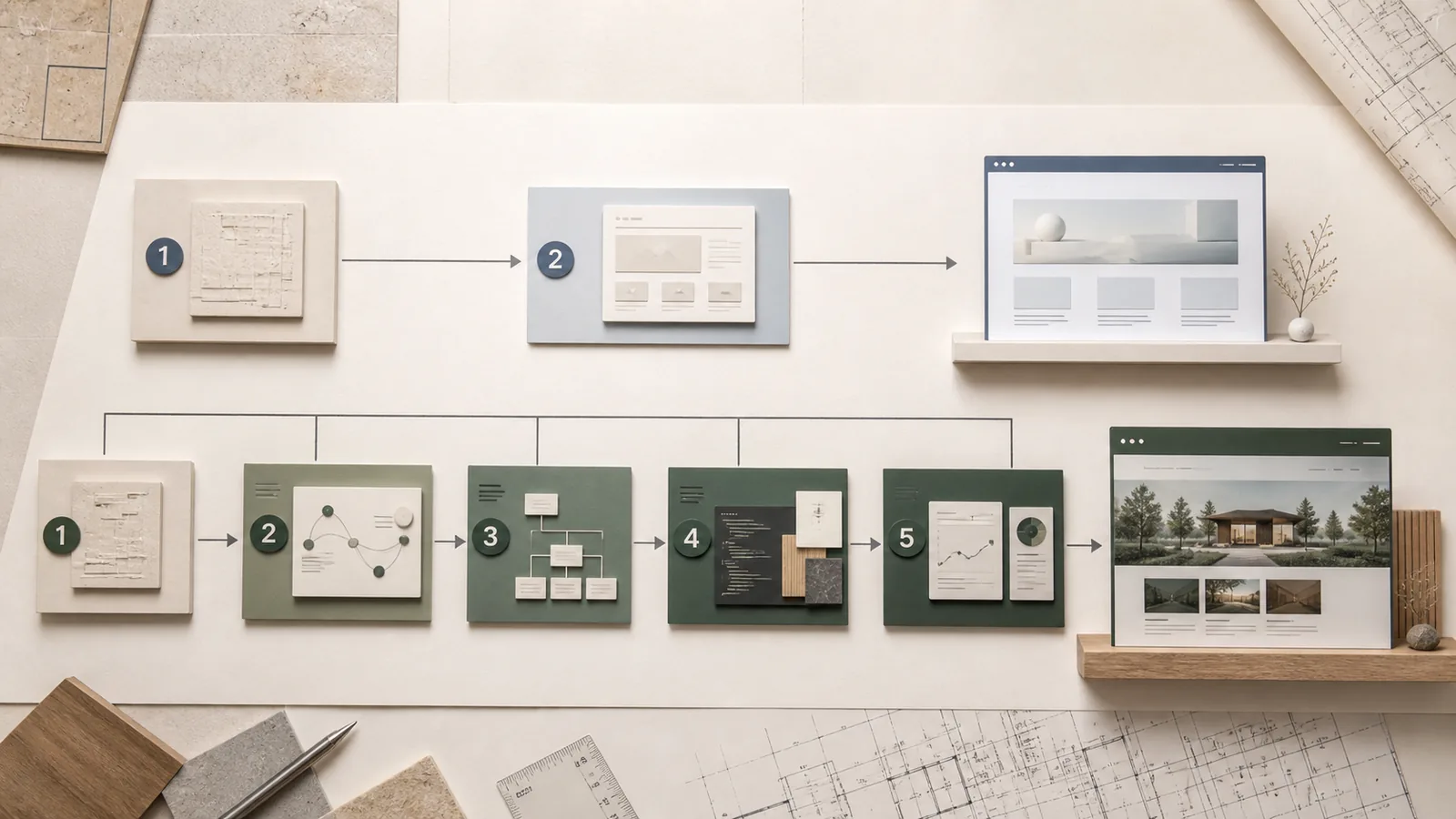
AI website builder vs WordPress is a choice between two different business workflows. An AI website builder can create a convincing first draft in minutes; tailor-made WordPress is designed to become a durable business system. The right choice depends less on which tool looks more impressive in a demo and more on what the website must achieve after launch.
If the goal is to validate an idea, publish a simple campaign or create a temporary presence, AI generation can be remarkably useful. If the website must win trust, rank for competitive searches, integrate with operations and improve conversions over time, a tailored build usually offers more control and a longer runway.
AI website builder vs WordPress: what is the real difference?
An AI website builder turns prompts and a small amount of business information into layouts, copy and visual suggestions. It optimises for speed and a plausible result. Tailor-made WordPress development begins with the business model, customer journey, search demand, content operations and technical requirements, then builds a system around them.
In an AI website builder vs WordPress comparison, the issue is not simply “AI versus a developer”. AI is increasingly present in both workflows. The important distinction is between generation from general patterns and design around specific evidence.
Where AI website builders are genuinely useful
Rapid validation
When a founder needs to test a proposition this week, a generated landing page can be more valuable than a perfect website delivered months later. It creates something concrete to discuss with customers and investors.
Simple, short-lived campaigns
Event pages, internal prototypes and temporary campaigns often have limited integration or content needs. In these cases, the convenience of an AI builder can outweigh the benefits of custom architecture.
Starting a creative conversation
Generated layouts can expose preferences quickly. A team may discover that it wants a quieter visual language, a clearer offer or fewer sections. Used as a sketch, AI accelerates discussion.
The limitation appears when the draft is mistaken for a finished strategy. AI can arrange familiar ingredients, but it does not automatically know why customers hesitate, what makes the company credible, which service produces the best margin or how internal teams will maintain the site.
Where tailor-made WordPress creates more business value
Strategy before interface
A tailored project asks what the website must change: more qualified enquiries, more direct bookings, stronger local visibility, better ecommerce conversion or less administrative work. Pages, journeys and calls to action follow that objective.
Search architecture and GEO
Competitive visibility requires more than generated copy. It needs a search-intent map, internal linking, authoritative evidence, structured data and pages that answer real customer questions. Our pillar guide to Generative Engine Optimization explains how this foundation also helps AI answer engines understand and cite a business.
Ownership and extensibility
WordPress is open-source software released under the GPL. The official WordPress features overview emphasises control over data, themes, plugins and custom development. A well-built WordPress site can integrate bookings, ecommerce, CRM, multilingual content, analytics and bespoke workflows without being limited to one builder’s roadmap.
Performance and accessibility decisions
Generated pages can look polished while carrying unnecessary scripts, weak hierarchy or inaccessible interactions. Tailored development makes those trade-offs explicit and tests them against real devices, content and users.
Continuous improvement
A serious website is never “done”. Analytics, search data, conversion behaviour and sales feedback should inform what changes next. A maintainable WordPress system gives a business room to evolve rather than start again.
AI website builder vs WordPress: practical comparison
| Decision | AI builder | Tailored WordPress |
|---|---|---|
| Launch speed | Very fast first version | Longer discovery and build |
| Strategic fit | Pattern-based | Designed around the business |
| Ownership | Platform-dependent | Open and portable when built well |
| Integrations | Curated catalogue | Plugins, APIs and custom code |
| SEO control | Varies by platform | Deep technical and editorial control |
| Best for | Validation and simple sites | Growth, differentiation and operations |
What does each option really cost?
For AI website builder vs WordPress decisions, the cheapest launch is not always the lowest-cost decision. Include subscription increases, migration difficulty, staff time, conversion losses, missing integrations and the cost of rebuilding. Equally, not every business needs custom development on day one. Paying for complexity before the model is proven is also wasteful.
Choose the smallest website that can support the next credible stage of the business—not merely the fastest tool available today.
How to choose: seven questions
- Is this a test or a long-term commercial asset?
- Does the website need unique customer journeys?
- Will organic search and AI visibility drive acquisition?
- Which systems must it connect to?
- Who will own and update the content?
- What happens if the current platform changes price or direction?
- How will performance and conversions be measured after launch?
When evaluating AI website builder vs WordPress, if the answers involve differentiation, complex integrations, multilingual growth, ecommerce or measurable lead generation, tailored WordPress is usually the stronger foundation. Explore JR Studio’s WordPress design and development approach for the strategic process behind the build.
The smarter answer is often a hybrid workflow
AI and tailored development are not enemies. AI can accelerate research synthesis, initial wireframes, content inventories, testing scenarios and repetitive production. Human specialists should still own positioning, information architecture, brand judgment, accessibility, technical decisions and final accountability.
This hybrid approach preserves speed without outsourcing the business strategy to a prompt. The result is not “AI-made” or “human-made”. It is deliberately designed, with the right tool used at each stage.
Frequently asked questions
Can an AI website rank on Google?
Yes, if it is crawlable, useful, technically sound and supported by authority. AI generation itself is not a ranking advantage. Quality, originality, intent and implementation matter.
Is WordPress becoming obsolete because of AI?
No. AI changes how websites are planned and produced, while WordPress remains a flexible publishing and application platform. Its value is control, extensibility and ownership.
Is a custom WordPress website always better?
No. A temporary experiment may not justify a tailored build. The better choice matches the risk, lifespan and commercial importance of the project.
Can I migrate from an AI builder to WordPress later?
Usually, but the process may require rebuilding templates, content structures, forms and integrations. Export options vary, so assess portability before committing.
How should a business use AI during a WordPress project?
Use it to accelerate bounded tasks while maintaining human review, source verification, brand standards and responsibility for the final website.
A website should solve the business—not simply generate a page
The final AI website builder vs WordPress decision should balance speed with judgment. The strongest digital presence combines both. Use an AI builder when learning quickly is the primary objective. Invest in tailored WordPress when the website must become part of how the business is found, trusted and operated.
Unsure which route fits your business? Talk to JR Studio before committing to a platform.
About the author
Jonatan Rosales is the founder of JR Studio and a digital growth consultant specialising in WordPress, SEO, GEO, analytics and applied AI.
Editorial review: This comparison reflects hands-on website strategy and WordPress delivery experience. Platform capabilities can change; verify current commercial terms before deciding.
Transparency: AI supported research, drafting and visual production. JR Studio reviewed, verified and edited the final content.
This post is also available in:


Leave a Reply
Want to join the discussion?Feel free to contribute!