
What Is GEO (Generative Engine Optimization)?

AI search · Digital visibility · Business growth
GEO, or Generative Engine Optimization, is the practice of making a brand’s digital content easier for AI-powered search engines to find, understand, trust and cite. It does not replace SEO. It extends it into a search environment where people increasingly receive a composed answer instead of a list of blue links.
That shift changes an important question for every business. It is no longer enough to ask, “Can customers find our website?” We must also ask, “Can an AI system understand what we do, verify our claims and confidently recommend us?”
What is GEO (Generative Engine Optimization)?
Generative Engine Optimization is a content and authority strategy designed to increase the likelihood that a company, expert or website will appear in answers produced by systems such as Google’s AI experiences, ChatGPT, Microsoft Copilot, Perplexity and other generative search tools.
The term GEO became widely discussed after researchers introduced a framework for improving visibility in generative engine responses. Their work showed that elements such as clear citations, authoritative language, relevant statistics and well-structured information can affect how sources are represented. The original research is available in the paper GEO: Generative Engine Optimization.
In practical terms, GEO brings together technical SEO, editorial quality, entity clarity, digital PR, structured data and real-world credibility. Its purpose is not to manipulate an AI model. It is to remove ambiguity and give search systems better evidence.
GEO is the discipline of becoming a source that an answer engine can understand, verify and cite.
Why GEO matters now
Search behaviour is becoming more conversational. A potential customer can ask a detailed question—“Which website strategy would help a boutique hotel increase direct bookings?”—and receive a synthesized answer containing recommendations, comparisons and cited sources.
This creates both a visibility challenge and a business opportunity. When an answer is generated before the user visits a website, a brand can lose the click but still gain influence. If the brand is named, cited or used as supporting evidence, it can enter the customer’s consideration set much earlier.
For smaller businesses, this is especially relevant. Generative systems do not only need famous brands; they need the most useful and credible source for a specific question. A specialist with original experience, transparent evidence and focused expertise can be more useful than a large company publishing generic content.
GEO therefore supports three valuable outcomes:
- Discovery: helping AI systems identify the business and its areas of expertise.
- Trust: providing verifiable signals that support the company’s claims.
- Demand: influencing customers before they reach a conventional search result or sales page.
How generative search engines select information
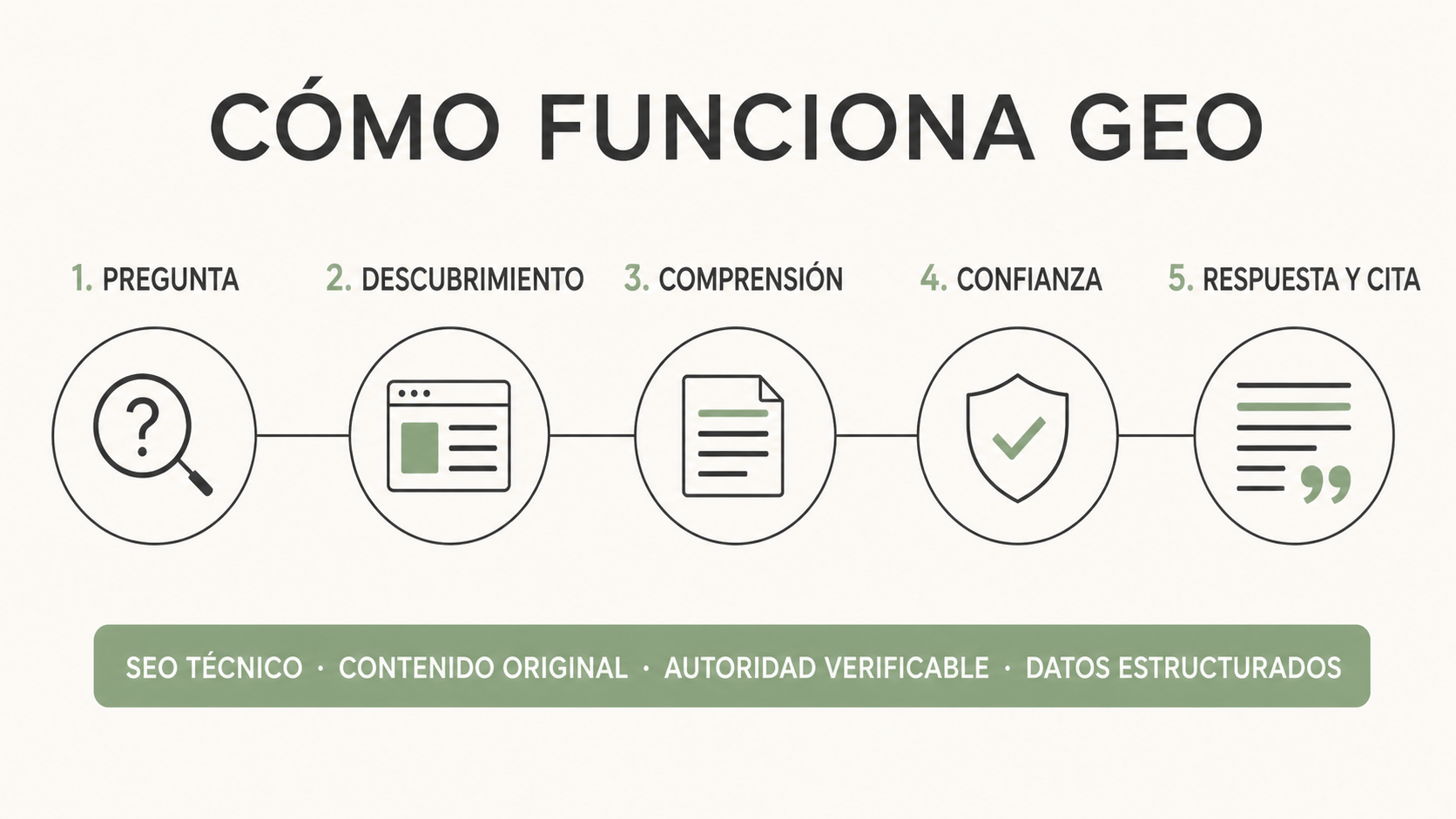
Generative engines do not all work in exactly the same way. Some retrieve live web pages, some rely on indexed information, and some combine search results with model knowledge. However, the path from question to answer usually includes a similar set of decisions:
- Interpret the intent. The system identifies what the user is really trying to decide, learn or compare.
- Retrieve relevant sources. It searches for pages, passages, entities and evidence related to the question.
- Evaluate usefulness and confidence. It compares topical relevance, source quality, clarity, corroboration and freshness.
- Synthesize an answer. It combines selected information into a concise response.
- Attribute sources where appropriate. It may cite or link to pages that support important statements.
This is why isolated keyword placement is not enough. A page can rank for a phrase and still be difficult for a generative engine to use. The content must answer a recognisable question, define its subject clearly, support important claims and connect the author to a credible area of expertise.
Google’s guidance on AI features and your website reinforces a useful principle: the same foundations that help normal search—accessible pages, helpful content, good internal linking and accurate structured data—remain essential in AI search.
GEO vs SEO: what is the difference?
SEO aims to improve visibility in traditional search results. GEO aims to improve visibility and attribution inside generated answers. The two disciplines overlap heavily, but the unit of success is different.
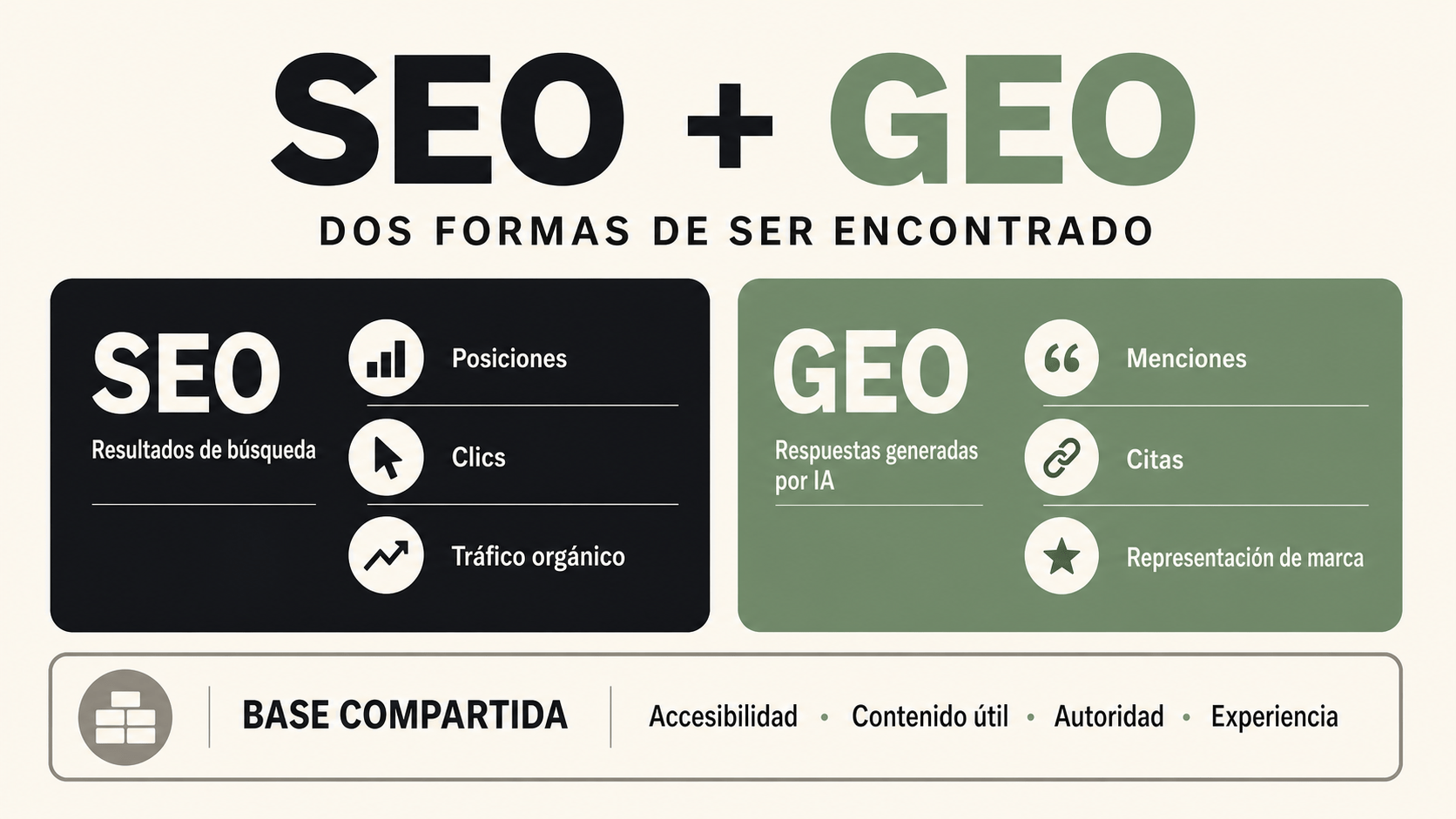
| Area | SEO | GEO |
|---|---|---|
| Primary goal | Rank and earn qualified clicks | Be understood, mentioned and cited |
| Typical surface | Search results page | AI-generated answer |
| Content emphasis | Intent, relevance and usability | Answer clarity, evidence and attribution |
| Core metrics | Rankings, clicks, traffic, conversions | Mentions, citations, referral traffic, assisted demand |
A sound strategy does not choose between them. Strong technical SEO makes content discoverable; GEO makes that content easier to interpret and reuse. The best approach is one integrated search strategy built around genuine customer questions.
What makes a website a citable source?
AI systems need more than confident prose. They need information that is specific enough to extract and credible enough to support an answer. The strongest pages usually combine the following qualities.
Clear, self-contained answers
Each important section should answer one question directly. A definition near the beginning of a section is easier to retrieve than an answer hidden inside a long introduction. Descriptive headings also help both readers and machines understand the page.
First-hand experience
Original examples, processes, observations and results are difficult to replace with generic summaries. Explain what you did, who it was for, what changed and what limitations existed. This is also one of the clearest ways to strengthen E-E-A-T: experience, expertise, authoritativeness and trust.
Evidence and attribution
Link important factual claims to primary or authoritative sources. Name the research, organisation or standard rather than using vague phrases such as “studies show”. Where your own data is involved, explain the method and timeframe.
Consistent entity information
A company name, location, services, founder and specialist areas should be consistent across the website and trustworthy external profiles. An AI system should not have to guess whether two descriptions refer to the same business.
Accessible technical foundations
Important content should be crawlable, fast, mobile-friendly and present in meaningful HTML. Structured data can clarify authorship, article details, organisation information and breadcrumbs, but it must accurately represent the visible page.
How to apply GEO to your website
GEO works best as a repeatable editorial and business process, not as a one-off optimization. The following framework is a practical place to begin.
1. Map the questions that influence a decision
Start with the questions customers ask before buying, not with a list of services. Include definitions, comparisons, costs, risks, suitability, implementation and expected outcomes. Sales calls, contact forms and support conversations are often better research sources than a keyword tool alone.
2. Create one authoritative page for each core topic
Build a clear pillar page and connect it to narrower supporting articles. A digital growth consultancy might publish a central guide to AI search visibility, then support it with focused pieces on GEO audits, content structure, local visibility and measurement.
This topic architecture helps readers explore naturally and makes relationships easier for search systems to understand. It should also connect editorial content to relevant commercial pages. For example, a reader who needs implementation help can learn about JR Studio’s web design and development approach or start a conversation.
3. Write the direct answer first
Open each section with the essential answer, then add context, examples and nuance. This inverted-pyramid structure feels editorial rather than mechanical when the writing remains natural. It also creates passages that can stand on their own when retrieved.
4. Add evidence that deserves to be cited
Use original research, expert commentary, documented processes, verified statistics and primary sources. If a claim is based on professional judgement, say so. Transparent uncertainty creates more trust than false precision.
5. Make authorship and accountability visible
Include a named author, relevant experience, an editorial review process and a publication or update date. Maintain a useful About page and real contact information. Trust is built across the entire site, not only inside one article.
6. Strengthen internal links
Internal links show how expertise is organised and guide visitors towards the next useful step. Use descriptive anchor text. Link from supporting articles back to the pillar, between genuinely related guides, and from informative content to an appropriate service or contact page.
7. Add accurate structured data
For a guide like this, Article structured data can communicate the headline, author, dates and featured image. Breadcrumb markup clarifies hierarchy. FAQ markup should only be considered when the questions and answers are visible and the implementation follows current search-engine policies.
8. Review, update and test
AI search changes quickly. Revisit important pages when evidence, products or customer questions change. Test representative prompts across several engines, record which sources appear and look for patterns—without treating a single answer as a stable ranking.
Common GEO mistakes
Publishing large volumes of generic AI content
Scale does not create authority. Content that merely rearranges information already available elsewhere gives an answer engine little reason to cite the new page. AI can support research and production, but the final work needs judgement, verification and a distinctive contribution. Google’s guidance on responsible use of generative AI content focuses on usefulness and quality rather than the tool used.
Optimizing for a list of keywords instead of an audience
Repeating “GEO optimization” does not prove expertise. Answer the real decision behind the query and use terminology naturally. A useful article should remain valuable even if the search interface changes.
Making claims without evidence
Superlatives such as “best”, “leading” or “guaranteed” weaken credibility when they are unsupported. Replace them with documented experience, clear scope and verifiable outcomes.
Treating schema as a shortcut
Structured data explains content; it does not rescue weak content. Markup must match what a visitor can actually see and should never invent reviews, credentials or FAQs.
Ignoring brand information outside the article
A strong guide cannot compensate for inconsistent company details, an anonymous author or an incomplete website. GEO is partly a content discipline and partly an organisational credibility project.
Measuring only website clicks
Some AI-assisted discovery will influence a customer without producing a direct referral. Ask new leads how they found the business, monitor branded search and evaluate the quality of enquiries alongside traffic.
How to measure GEO performance
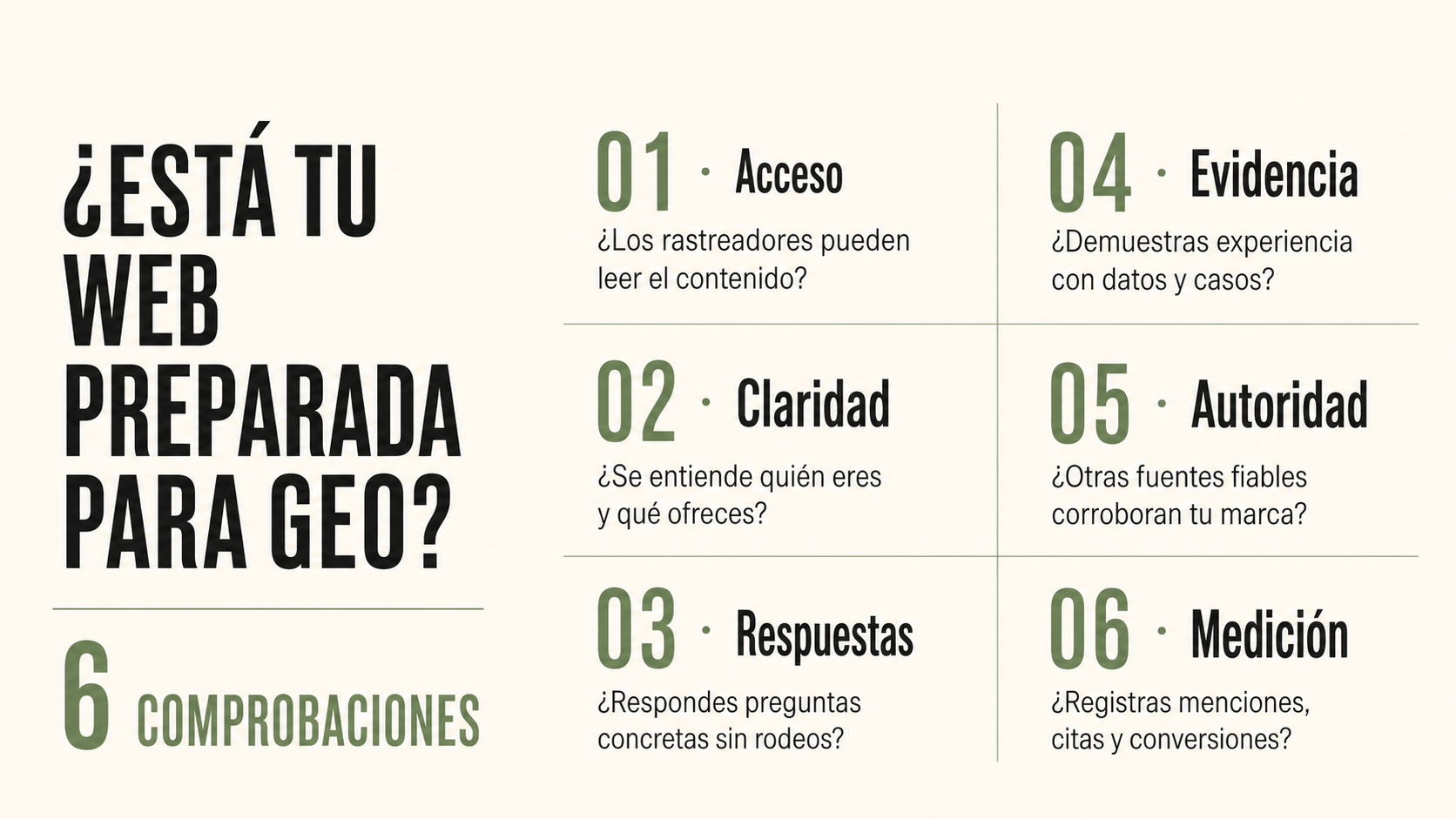
There is no single universal GEO score. Measurement requires a small group of indicators observed over time.
- AI mentions and citations: whether the brand or page appears for a controlled set of relevant prompts.
- Referral traffic: visits from AI products when referral data is available.
- Branded demand: changes in searches for the company, founder or proprietary concepts.
- Search visibility: rankings, impressions and clicks for the questions that feed generative answers.
- Qualified enquiries: leads that mention AI research, a specific article or a complex problem addressed by the content.
- Citation readiness: the proportion of priority pages with clear answers, named authors, evidence, current dates and useful internal links.
Create a repeatable prompt set based on real customer situations. Test it monthly, from a consistent location and without overinterpreting minor fluctuations. Generative answers are probabilistic and personalised; the goal is to identify durable visibility patterns.
OpenAI also explains how publishers can manage discovery and referral visibility in its publishers and developers FAQ. Policies and product behaviour can evolve, so primary documentation should be reviewed regularly.
A practical GEO strategy for a growing business
A business does not need to optimize every page at once. Begin with the areas closest to revenue and expertise.
- Choose three high-value customer problems. Select questions that frequently appear before an enquiry or purchase.
- Audit the current evidence. Identify case studies, data, credentials, processes and expert observations that already exist.
- Build or improve the pillar pages. Give each problem a comprehensive, well-structured resource with a direct answer.
- Create supporting proof. Publish narrower articles, examples and case studies that substantiate the main guide.
- Connect the journey. Add contextual internal links and a calm, relevant conversion path.
- Measure visibility and commercial impact. Track citations, search demand and qualified conversations—not vanity output.
The strategic advantage is not “writing for robots”. It is documenting expertise so clearly that people and machines reach the same conclusion: this business understands the problem and can help solve it.
JR Studio approaches GEO as part of a wider digital growth system: search strategy, website quality, brand authority, analytics and conversion must reinforce one another. You can explore more practical thinking in the JR Studio knowledge hub.
Frequently asked questions about GEO
What does GEO stand for?
GEO stands for Generative Engine Optimization. It is the practice of improving how a brand and its content are discovered, understood and cited by AI-powered search and answer engines.
Does GEO replace SEO?
No. GEO builds on SEO. Search engines and AI systems still need accessible pages, relevant content, internal links, authority and reliable information. SEO supports discovery; GEO adds emphasis on extractable answers, evidence, entities and citations.
Which platforms does GEO target?
GEO can improve readiness for generative experiences in Google Search, ChatGPT, Microsoft Copilot, Perplexity and similar tools. Each product uses different retrieval and citation systems, so no optimization can guarantee inclusion.
How long does GEO take to work?
There is no fixed timeline. A technically healthy and authoritative site may see changes sooner, while a new brand often needs months to build evidence, coverage and topical depth. GEO should be treated as continuous improvement.
Can a local business benefit from GEO?
Yes. Local businesses can publish precise information about services, locations, suitability, pricing factors and common customer decisions. Consistent business details, genuine reviews, local authority and useful expert content are especially important.
Can AI-generated content rank or be cited?
It can, but the production method is not the main quality signal. The content must be helpful, accurate, original enough to add value and reviewed by someone accountable. Unverified mass-produced content creates reputational and search risk.
Is GEO only a content task?
No. It also involves technical accessibility, structured data, brand consistency, off-site authority, measurement and conversion design. The article may earn visibility, but the wider website must turn that visibility into trust.
How can I start with GEO?
Choose one commercially important customer question, create the clearest evidence-led answer you can, connect it to relevant supporting pages and measure how it appears across traditional and AI search. If you need a joined-up plan, contact JR Studio.
GEO is a clarity and credibility advantage
Generative search is changing the route between a question and a business. The strongest response is not to chase every new platform feature. It is to become unmistakably useful: publish clear answers, show first-hand experience, cite reliable sources, maintain strong technical foundations and make the identity behind the advice visible.
That work improves more than AI visibility. It creates a better website, a more trusted brand and a stronger buying journey. In that sense, GEO is not a speculative layer added to marketing. It is a disciplined way to make real expertise legible in the next generation of search.
About the author
Jonatan Rosales is the founder of JR Studio and a digital growth consultant specialising in web strategy, SEO, GEO, analytics and applied AI. He helps businesses get found, sell more and work smarter.
Editorial review: This guide draws on primary research and official documentation from Google and OpenAI. It was reviewed for clarity, accuracy and practical relevance on 6 August 2026.
Transparency: AI supported research, drafting and visual production. JR Studio reviewed and edited the final content.
This post is also available in:


Leave a Reply
Want to join the discussion?Feel free to contribute!