
EU AI Act Transparency: A Practical 2026 Guide for Businesses

AI governance · Editorial transparency · European business
EU AI Act transparency rules now affect how certain AI interactions and AI-generated or manipulated content must be disclosed. Since 2 August 2026, Article 50 has applied across the European Union. For businesses, the practical challenge is not to attach a dramatic warning to everything touched by AI. It is to understand which uses require disclosure, where human editorial control changes the position, and how to communicate transparently without damaging the experience.
This EU AI Act transparency guide translates the law into a practical publishing and customer-experience workflow. It is general information, not legal advice; organisations should assess their own role, use case and sector with qualified counsel.
EU AI Act transparency: what changed in August 2026?
Article 50 of the EU AI Act became applicable on 2 August 2026. It introduces transparency duties for providers and deployers of specific AI systems. The objective is simple: people should know when they are interacting with AI or when certain content has been artificially generated or manipulated.
The official European Commission guidelines on AI-generated content explain how the obligations apply. The definitive legal text remains Regulation (EU) 2024/1689, particularly Article 50.
This matters because “using AI” describes many different activities. A chatbot speaking directly with a customer is not the same as an editor using AI to reorganise notes. A photorealistic synthetic video is not the same as removing dust from a product photograph. The legal analysis depends on the role, output and context.
Provider, deployer or ordinary user: why your role matters
The AI Act distinguishes between organisations that provide AI systems and those that deploy them. A provider develops an AI system or places it on the market under its own name. A deployer uses an AI system under its authority, except for purely personal activity.
For EU AI Act transparency, many SMEs will primarily be deployers. Examples include a hotel using an AI concierge, a retailer publishing a synthetic campaign video, or a professional-services firm using a chatbot to answer prospective clients. Agencies can occupy different roles depending on whether they merely configure a third-party tool or offer an AI system under their own name.
Transparency begins by mapping the experience: who built the system, who controls its use, what the audience sees and who takes responsibility for the result.
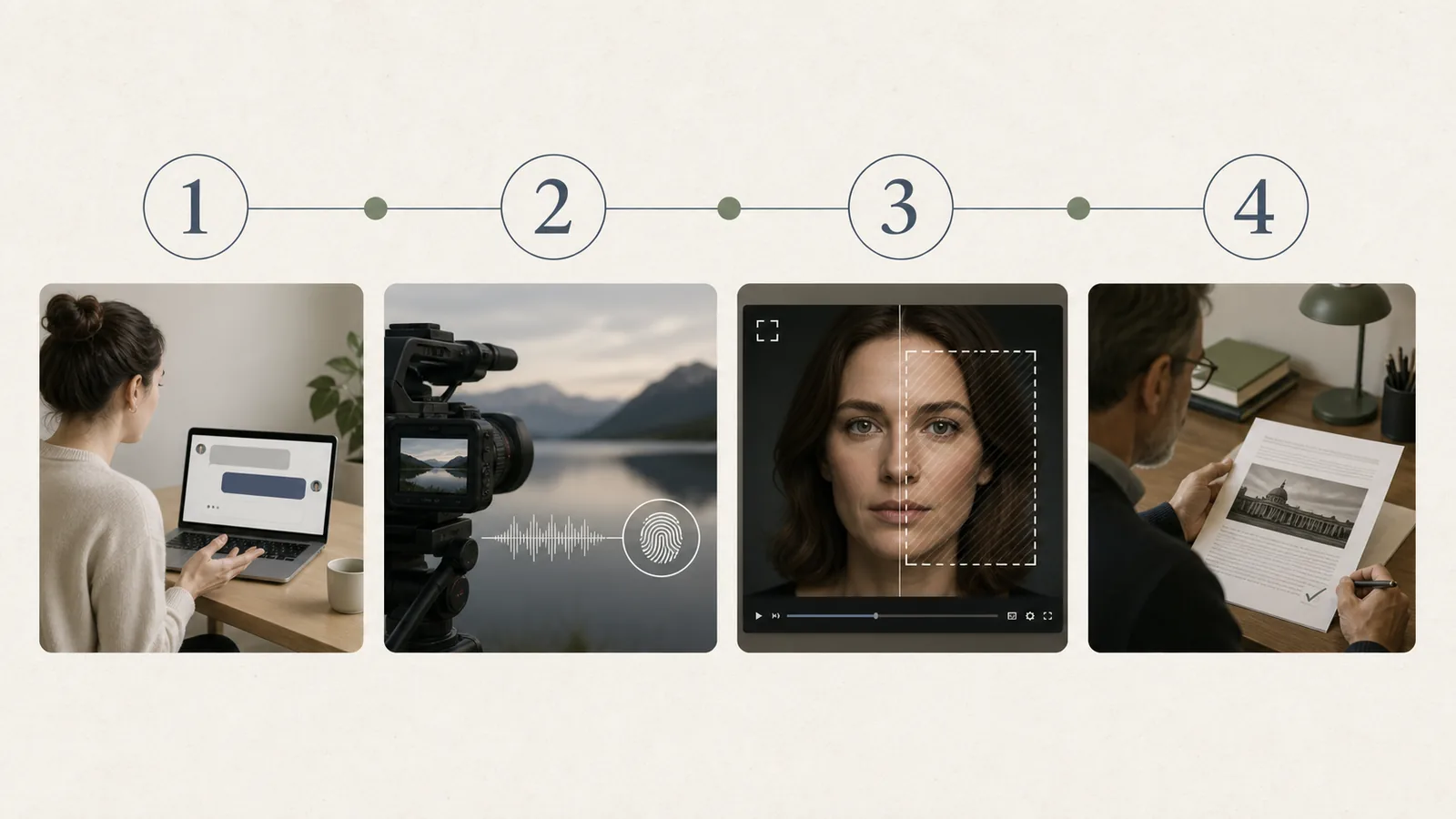
The four AI transparency situations businesses should recognise
1. People interacting directly with an AI system
Providers must design systems so people are informed when they are interacting with AI, unless that fact is obvious to a reasonably informed and attentive person. In practice, a customer-service bot should identify itself clearly at the beginning of the interaction—not bury the information in a privacy policy.
2. Machine-readable marking of synthetic output
Providers of systems that generate synthetic text, audio, images or video must make those outputs detectable in a machine-readable form, as far as technically feasible. This is primarily a system-level responsibility. It is different from the visible caption a publisher may add for readers.
3. Deepfakes and realistic manipulated media
Deployers that publish AI-generated or manipulated image, audio or video constituting a deepfake must disclose its artificial origin. Creative, satirical or fictional works receive a proportionate treatment: disclosure may be made in a way that does not spoil the experience, but the artificial nature still needs to be communicated.
4. AI-generated public-interest text
Deployers publishing AI-generated or manipulated text to inform the public on matters of public interest must disclose that use. The Act provides an important exception where the content has undergone human review or editorial control and a natural or legal person holds editorial responsibility.
That exception does not make transparency a bad idea. A discreet editorial note can still strengthen trust, document the workflow and set a clear standard across a company’s publishing activity.
Does every AI-assisted blog post need a label?
No: the EU AI Act does not impose the same visible label on every piece of AI-assisted content. The answer depends on whether the text concerns a matter of public interest, whether it was generated or manipulated by AI, and whether meaningful human review and editorial responsibility exist.
A sound EU AI Act transparency policy also distinguishes legal compliance from good editorial practice. A business may choose to disclose AI assistance more broadly than the minimum required. JR Studio’s approach is to keep the notice small, specific and human-centred: explain what AI supported, confirm human review and avoid implying that an unverified machine produced the final work.
For organisations building visibility in AI search, this supports E-E-A-T as well. Clear authorship, sources, review dates and responsibility help both readers and machines understand who stands behind a claim. Our guide to Generative Engine Optimization explains why that evidence also matters for citations in AI answers.
A practical AI transparency workflow for businesses
- Inventory the use case. Record where AI interacts with customers or generates text, images, audio and video.
- Define your role. Establish whether the business is acting as provider, deployer, distributor or ordinary end user.
- Classify the output. Separate assistive editing from substantial generation or manipulation, and identify deepfakes or public-interest material.
- Assign human responsibility. Name the person or team that verifies accuracy, rights, privacy, brand suitability and publication.
- Choose the right disclosure layer. Use an opening chatbot message, visible media label, caption, end note or machine-readable marker as the situation requires.
- Keep evidence. Retain the prompt brief, source list, approvals, asset provenance and publication date where proportionate.
- Review accessibility. Article 50 requires information to be clear, distinguishable and accessible at the first relevant interaction or exposure.
The Commission has also published a Code of Practice on transparency of AI-generated content. It is intended to help organisations demonstrate compliance, but signing a code does not replace understanding the legal requirements that apply to a specific use.
Practical disclosure examples
| Use | Clear wording |
|---|---|
| Customer-service assistant | “You’re chatting with JR Studio’s AI assistant. A human can take over when needed.” |
| Editorial illustration | “AI-generated illustration for explanatory purposes; reviewed by the editorial team.” |
| AI-assisted article | “AI supported research and drafting. The final article was verified and edited by [name/company].” |
| Synthetic spokesperson video | “This video contains an AI-generated presenter.” |
A disclosure should be close enough to the experience that a person notices it before being misled. Small does not mean hidden. The wording should be proportional, readable and specific.
What businesses should do now
For effective EU AI Act transparency, start with the customer-facing systems and realistic media most likely to create confusion. Then document the quieter uses of AI in marketing, publishing and operations. This creates one coherent governance system instead of scattered labels.
The strongest implementation combines legal review, editorial policy, UX writing, accessibility and technical provenance. If your organisation is redesigning its publishing workflow or customer experience, JR Studio can integrate transparency into the website and content system rather than treating it as a last-minute disclaimer.
Frequently asked questions
When did the EU AI Act transparency rules start to apply?
The Article 50 transparency obligations apply from 2 August 2026. Some system-level marking obligations may have transitional arrangements for systems placed on the market earlier; consult the current Commission guidance for the exact scope.
Must a chatbot say that it is AI?
Generally, people must be informed when they are interacting directly with an AI system unless that is obvious in context. The notice should appear no later than the first interaction.
Must every AI-generated image carry a caption?
Not every image is treated identically. Deepfakes and realistic manipulated media receive specific attention. A clear caption is nevertheless a strong editorial practice because it reduces ambiguity and records provenance.
Is human review enough to avoid all disclosure duties?
No. Human editorial review is relevant to the exception for certain public-interest text, but it does not remove separate duties concerning AI interaction, deepfakes or system-level marking.
What records should an SME keep?
A proportionate record can include the tool, purpose, responsible reviewer, source material, approval, disclosure used and publication date. Higher-risk or regulated uses need a more formal assessment.
Transparency should increase trust, not interrupt the work
EU AI Act transparency turns compliance into a design and governance question. The best response is not a wall of legal text. It is a clear signal, placed at the right moment, supported by real human responsibility.
Need a practical AI-content and website transparency workflow for your business? Talk to JR Studio.
About the authorJonatan Rosales is the founder of JR Studio and a digital growth consultant specialising in web strategy, SEO, GEO, analytics and applied AI. He helps businesses get found, sell more and work smarter.
Editorial review: This guide is based on Regulation (EU) 2024/1689 and European Commission guidance available on 6 August 2026. It has been reviewed for clarity and practical relevance. It is not legal advice.
Transparency: AI supported research, drafting and visual production. JR Studio reviewed, verified and edited the final content.
This post is also available in:



Leave a Reply
Want to join the discussion?Feel free to contribute!